Tuesday, 3 July 2012
Now equipped to receive WSPR
I have installed the WSPR datacomms software on my computer, so am ready to receive this mode on 136kHz, 472kHz and 500kHz. I cannot transmit WSPR because it needs a linear transmitter and my 136kHz Tx is Class-D. You can download software and documentation for WSPR and other modes from here.

Opera / CW on 500kHz
Received Opera 4 signals on 502kHz from PA0A (+3dB signal/noise at 465km), and PA3ABK (+1dB S/N at 338km). CW ident fom PA3ABK was audible at 579.
Monday, 2 July 2012
Summer LF Radio Conditions
Low frequency activity tends to fall off during the summer. Some of this is due to holidays and the need to spend more time working out of doors. But some is also due to a perception that propagation is poor in the summer months.
In fact, sky-wave propagation is still available but, because long distance contacts require darkness over most of the path, the number of hours of propagation in reduced. DF7FC is carrying out an exercise to demonstrate that he can be received in the US during every month of the year. He has succeeded so far, even in June.
Availability of medium distance sky-wave (eg UK-Moscow) is also reduced but contacts are still possible. Local contacts are often easier in the summer, with less multi-path fading.
A major summer issue is QRN - static from thunder storms - which can carry hundreds of kilometres (for current storm maps see: Americas , Europe/Africa or East Asia/Indonesia
for a continuously updated map of storms worldwide). There are some days without storms, so daily checking is worthwhile, and the static levels are usually greatly reduced in the mornings.
Choice of mode is important. For instance QRSS will outperform CW in high static conditions..
So why not dust off the LF transmitter and try out some summer activity? You may well be surprised.
In fact, sky-wave propagation is still available but, because long distance contacts require darkness over most of the path, the number of hours of propagation in reduced. DF7FC is carrying out an exercise to demonstrate that he can be received in the US during every month of the year. He has succeeded so far, even in June.
Availability of medium distance sky-wave (eg UK-Moscow) is also reduced but contacts are still possible. Local contacts are often easier in the summer, with less multi-path fading.
A major summer issue is QRN - static from thunder storms - which can carry hundreds of kilometres (for current storm maps see: Americas , Europe/Africa or East Asia/Indonesia
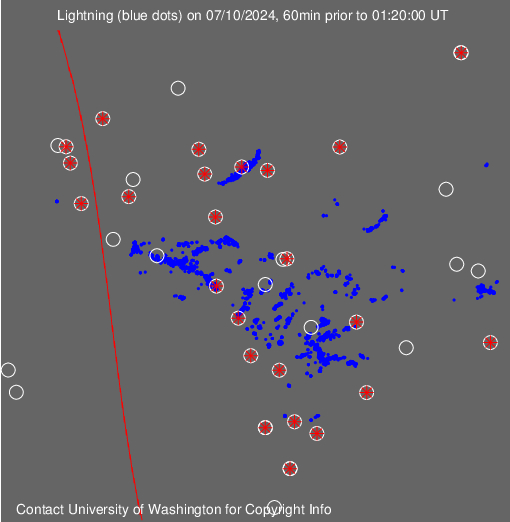
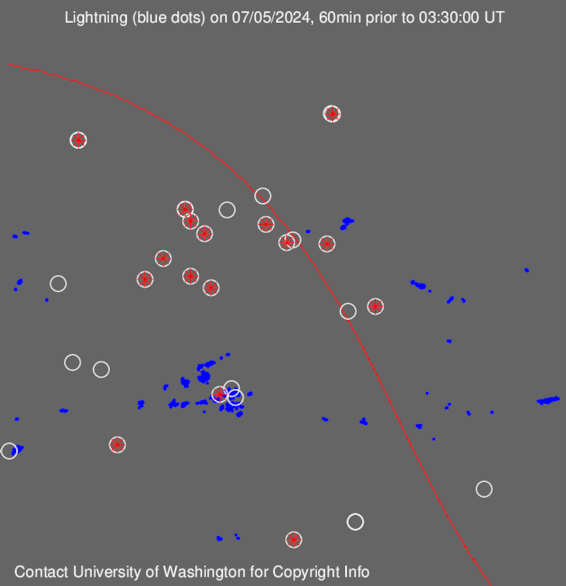
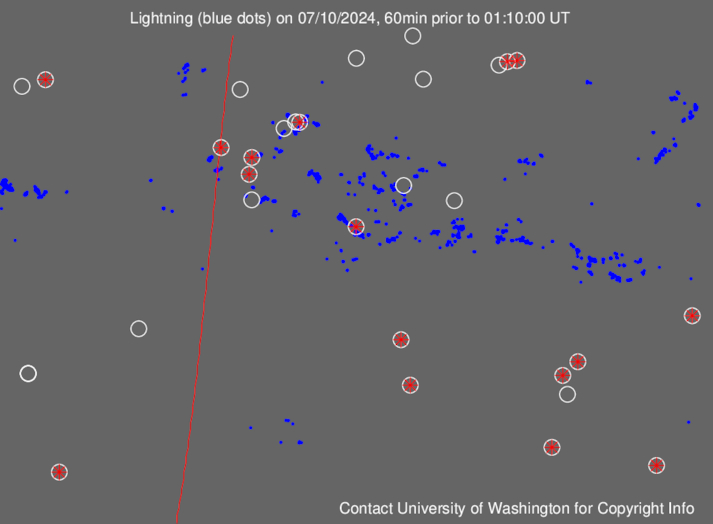
for a continuously updated map of storms worldwide). There are some days without storms, so daily checking is worthwhile, and the static levels are usually greatly reduced in the mornings.
Choice of mode is important. For instance QRSS will outperform CW in high static conditions..
So why not dust off the LF transmitter and try out some summer activity? You may well be surprised.
Sunday, 1 July 2012
Activity on 30 June
I called CQ using QRSS3 on 137.7kHz at 0850 and 1630UTC, but no reply. Static was bad on that band.
I retuned the antenna to 500kHz and received the following stations using Op4 (best signal/noise in brackets): G3XBM (-13dB), M0FMT (-1), PA3ABK (0), PA0A (0).
Listened on 477kHz but no amateur signals heard.
I retuned the antenna to 500kHz and received the following stations using Op4 (best signal/noise in brackets): G3XBM (-13dB), M0FMT (-1), PA3ABK (0), PA0A (0).
Listened on 477kHz but no amateur signals heard.
Subscribe to:
Posts (Atom)