Yesterday morning I heard a CW contact between G3XIZ (599+) and M0JXM (599), but little else on this band.
Later, I monitored 472kHz and received WSPR transmissions from: DF6NM from 2056 to 0252 UTC, peaking at -9dB signal to/noise and DK6NI from 2134 to 2318 peaking -26dB S/N. Static levels on my receiver were the lowest for a couple of weeks.
Monday, 9 July 2012
Saturday, 7 July 2012
Improving IC-706 on LF/MF
Icom's old IC-706 (I use one of the first Mk1 models) is a good, cheap radio for receiving on 136kHz and 472/500kHz. Its sensitivity is not good enough for a poor antenna, but if you have a decent size tuned Marconi suitable for transmitting, it is more than adequate. The receiver pre-amplifier even works at 136kHz.
One advantage is its impressive frequency stability - after a few tens of millihertz warm up, my 706 stays within 10mH forever! Tuning steps, and readout are 1Hz. These features make it very suitable for the extremely slow Morse (eg QRSS60) used for intercontinental working on 136kHz.
The main drawback is its intermodulation performance, especially in view of the very weak amateur radio signals found at LF/MF compared to the strong signals out-of-band signals received by the antenna. In my case the principle problem is the medium wave broadcast transmitters located at Brookman's Park, just 10km or so away (LF guru M0BMU is less than 1km from this station), and these can cause problems on 500kHz and 1.8MHz. To improve the suppression of unwanted signals, I use a G3YXM tuned preamplifier for 136kHz, and have just added a parallel-tuned circuit across the antenna coax when using 472/500kHz.
One advantage is its impressive frequency stability - after a few tens of millihertz warm up, my 706 stays within 10mH forever! Tuning steps, and readout are 1Hz. These features make it very suitable for the extremely slow Morse (eg QRSS60) used for intercontinental working on 136kHz.
The main drawback is its intermodulation performance, especially in view of the very weak amateur radio signals found at LF/MF compared to the strong signals out-of-band signals received by the antenna. In my case the principle problem is the medium wave broadcast transmitters located at Brookman's Park, just 10km or so away (LF guru M0BMU is less than 1km from this station), and these can cause problems on 500kHz and 1.8MHz. To improve the suppression of unwanted signals, I use a G3YXM tuned preamplifier for 136kHz, and have just added a parallel-tuned circuit across the antenna coax when using 472/500kHz.

Friday, 6 July 2012
Polish NDB "SA"
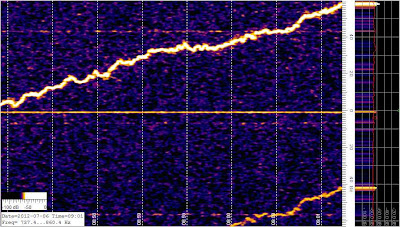
The 472-479kHz amateur band (available only in a few countries so far) has several aircraft beacons (see my main web site). One of the most prominent transmits "SA" in Morse on AM. The carrier is on 474.5kHz, and the Morse callsign sidebands can be heard approximately 1kHz above and below that frequency. It is quite loud after dark, but here is a Spectrogram (set to QRSS3) of the carrier during the daytime here. The straight line is "SA", and the big wobbly ones are from my plasma TV.

DL3ZID WSPR Received
I finally received WSPR transmissions from DL3ZID on 477.0kHz (dial frequency), despite huge static crashes. He is my best DX so far on this band at 800km. The software produced the following info:
120705 2036 3 -29 0.1 0.478585 DL3ZID JO53 23 0 8 0
120705 2048 5 -28 0.3 0.478585 DL3ZID JO53 23 0 3 0
120705 2058 7 -24 0.2 0.478585 DL3ZID JO53 23 0 1 0
120705 2110 2 -30 0.4 0.478586 DL3ZID JO53 23 0 5002 -1
120705 2120 7 -26 0.4 0.478583 DL3ZID JO53 23 0 1 0
120705 2036 3 -29 0.1 0.478585 DL3ZID JO53 23 0 8 0
120705 2048 5 -28 0.3 0.478585 DL3ZID JO53 23 0 3 0
120705 2058 7 -24 0.2 0.478585 DL3ZID JO53 23 0 1 0
120705 2110 2 -30 0.4 0.478586 DL3ZID JO53 23 0 5002 -1
120705 2120 7 -26 0.4 0.478583 DL3ZID JO53 23 0 1 0
Wednesday, 4 July 2012
DL3ZID on WPSR
DL3ZID ran a WSPR test on 477kHz this afternoon. Nothing seen here, however. Very bad storm static from France and Belgium did not help.
Subscribe to:
Posts (Atom)